Tuesday, 26 March 2013

Pinar Del Rio

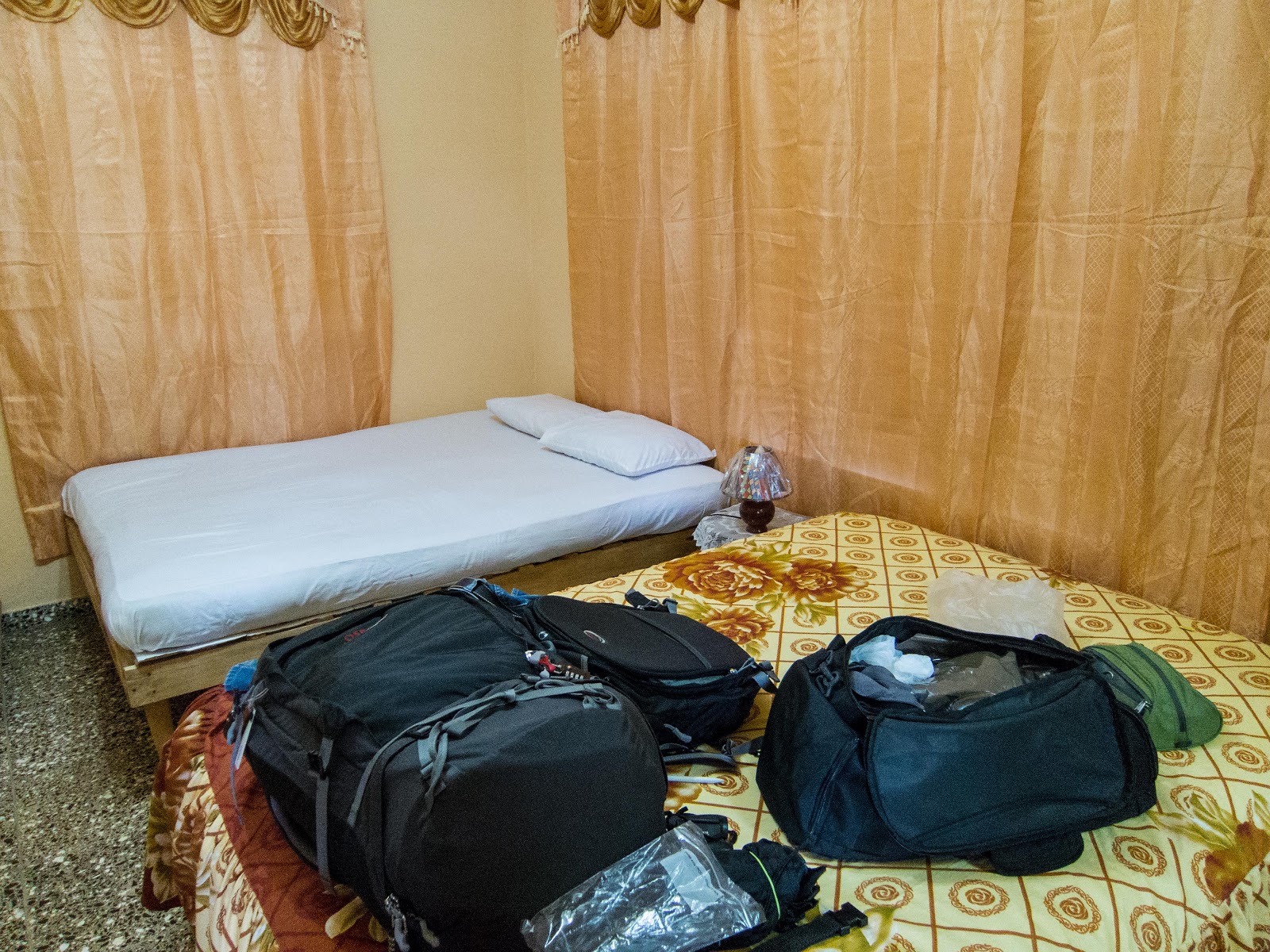
I had trouble sleeping last night due to one, the noise from the road outside - I was on the first floor. And two, the air conditioning was too cold. Finally I had to turn it off early in the morning to get some sleep, which wasn't much as my alarm then rang at seven. I had to retime it twice and finally woke up at 7.30am

After breakfast we met the other five joining us. I guess they will be saying the same thing "the other seven joining us". After introductions were made, we were briefed as to what we will be doing today and the rest of the week in summary. The other seven were telling us about Cuba and what to do and what not to do and their experiences to us 'newbies' because they have been in Cuba obviously longer than us but it soon dawned on me how much or little they actually knew. What they knew was the 'tourist' version of Cuba despite being on an Intrepid trip that was supposed to focus on the local aspect of the country. I then realised why. I had a personal local guide that was not bound by Intrepid rules while these people had to comply with the rules set by Intrepid. So, I wonder how bad would the other normal western tours would be. None of them had bought anything from a ration shop let alone been to one, none of them had ridden on a local bus - because foreigners were generally not allowed (due to the subsidy) and a lot of things I had done. So, doing a tour by yourself isn't a bad thing.

Anyway back to today. We checked out and loaded the minivan for the three hours drive from Havana to Vinales. The journey was uneventful other than the fact that the number of vehicles on the dual carriageway became less and less the more interior we went. I then started seeing just jungle and sometimes farms, orchard but there were also less people. Looks like the west is far less populated than the east of Havana.

The minivan
The place we visited today was the Vinales Valley which is situated in the Pinar Del Rio region. As we enter the region, I could tell why it is said to be beautiful. It resembled like the hillside of Padang in Indonesia. This part of Cuba apparently grows the best tobacco in the world and tomorrow we will be visiting a tobacco factory to see how it is made. I am going to buy one cigar even though no one in the family smokes and even if I risk it being confiscated by the US customs.

The view of Vinales
I also read that this region possesses unique ecosystems such as the Vinales National Park and the Guanahacabibes Biosphere Reserve. Both of these have been declared World Cultural Heritage Landscapes by UNESCO. The city however, is marked by its neoclassical architecture. The geography of the province embraces varied and exuberant vegetation, lots of endemic species in its flora, mineral and medicinal waters, beautiful valleys surrounded by mogotes and the biggest caves in Cuba.

As we were arriving at the valley, there were dark rain clouds just ahead of us. That was not a good thing as we were supposed to be going on a three hour jungle walk into the national park. After some narrow winding roads, we finally arrive at our casa for the next three nights. We unload the van and get our bags and head off to our respective casas and the rain starts. Perfect timing as a minute later and we together with our bags would have been soaked. 


I was ushered with two other ladies, the Canadian and a British, Laurie. I was wondering how this will work out but then when we got to the casa, realised that I had a single room. Looks like the other Australian, Tony from the other group had opted for a single room so by default, there being no other unpaired guys, I get a single room. How nice.


We ordered some sandwiches from the casa owner while waiting for the rain to subside. As we we having our lunch, we had a phone call from Natalia that the walk has been called off as the rain only got worse. But we were told meet up front at the main house at 4pm.

4pm came and we regrouped to decide what we wanted to do. Option one was to go on the nature walk and the second option was to go downtown and explore. Given the torrential rain we just had, option two was unanimous. We wondered down admiring the buildings and the various houses. Almost all of them supplemented their income with letting out their homes to tourists. I guess the number of homes being let out indicates the popularity of Vinales. We visited a local botanical garden that was started by two sisters who have since passed on but the gardens continue to flourish. There were an amazing display of flowers, plants and fruit trees. We then passed by a stall selling sugar cane juice. Natalia asked who wanted to try and only four of the twelve were brave enough to try something local. I was one of the four and it was really good. Just like the one we have in Malaysia.

Sugar cane drink
State clothing factory
On the way back to the casa, there was a band playing at a bar. So we all stopped to have a drink and listen to them play. It was fantastic music with just five people. The Cubans are so talented as they just played with no notes and it was rhythmic. As with their tradition, they pass their hats around for loose change after every few songs. They also try to sell their music on a CD to us for CUC5 each. Not sure what the quality is like. I was tempted to buy though but I'll see how it goes. I stil have two more days here. Apparently, the next stop is really remote and there is absolutely nothing but the beach. Not sure if I'll like it or hate it.


There were only the three of us here in this casa but dinner was an elaborate affair. They owner, Julie as she introduced herself, brought a fruit platter for each of us and a plate of greens for the table. After that came the starters. A soup/broth sort made with lentils and coconut and pieces of meat. I think it was chicken that was thrown in. And each bowl had two slices of pumpkin. It was delicious and also sweet and savoury at the same. Hard to explain but was good and filling. So, when the next course came which was the mains, it was hard to get everything in. The main was pork slice fried with garlic and slices of onion on top, with steamed sweet potato. Together with that came a bowl of black beans, which is a Cuban staple, and a bowl of rice. After all that, Julie asked us if she could now serve us dessert. The answer was no! But coffee would be great and it came in a small cappuccino cup which was good, thick and strong Cuban coffee.


After dinner, we went to check out the night scene in town. There is only one main street in town and three bars or night clubs and that's it so its difficult to get lost. The night club we went to was in the town square which was the biggest one. The entry fee or rather cover charge with no drinks included was CUC1. You buy whatever you wanted when you got in. The atmosphere was really fantastic. There was a live band playing and performances by a group of 5 girls. After every performance, there was the band and then after the band, the performance. Actually there was no pause in intertainment. It was like watching a movie with song and dance. Everybody just walked up to another person and they would do the salsa, which was really incredible to watch. Even the biggest person swayed gracefully to the music. We stayed till about close to midnight and walked back to the casa which was about 10 minutes away. Felt really safe walking back at that hour.


The night club thing was not what I expected it be. There were no rowdy people or drunks, there were many locals just having a bit of fun. At least to an outsider, it looked like clean fun and it wasn't even a Saturday night. Apparently, this happens every night.

Back in my room, I could still hear the loud music from the three night clubs. Not sure how the locals who live around here feel but as a tourist, it sure feels surreal, like being in a film set, and noisy especially when you are trying to get to sleep. 

Monday, 25 March 2013

Old Havana to Vedado

After getting used to the Casa Particular (spanish for home stay) and the three people (Alexandra, Galaksi and Vieena - their names I finally managed to find out with my limited Spanish) it was time to say goodbye to Old Havana where I was staying for four days and to now join the next leg of my Cuban adventure with Intrepid. I have so far ventured into much of the Old Havana and a little bit of the east side up to Hershey. This part of my trip will take me west to Vinales and then south to Maria La Gorda before returning to Old Havana.

My guide for the last two days, Dania, was nice enough to come pick me up and take me to Victoria Hotel. She said there were two more modes of transport for the locals that I have yet to experience so she wanted to get me on them. She firmly said no taxi or at least the taxi i was expecting. I got down the narrow staircase on the to street where she was waiting for me in a Bici Taxi (a taxi that is a modified bicycle that would carry two). The Bici Taxi is like a trishaw as it has three wheels and uses the muscle power of the rider. With my weight and the backpack, I felt pity the guy who was peddling. He took us to the Main Street where we could get a motorised taxi and my guide explained that Vedado is too far for the Bici Taxi. This ten minute ride cost us 1 Peso.


Some of the streets around the main square was closed off due to some celebration to precede Easter weekend, next week. So we had to get down and walk a little to catch a Coco Taxi. This is a modified motorcycle but in the shape of a coconut, therefore the name Coco Taxi. The rider was a lady and she whisked us away onto the main highway towards the west of Havana from Old Havana to Vedado. After a short 10 minute ride, we arrive at the Victoria Hotel. 


I was a little disappointed when I went to check in as my name was not on the Intrepid list. This trip is limited to 12 people and there were 12 names but my name was not one of them. I showed the guy at reception my travel voucher and he agreed to check me in and give me a room but he said to check with the local guide during the group meeting at 7.30 that night. I wasn't sure how they were going to spilt rooms with 13 people and the other issue was accommodation at the other places. I hoped they wouldn't exclude me as I came all this way and I wasn't prepared to leave without completing the trip.

This part of town was very different from the old Havana I stayed a few days ago. All the buildings were still pretty old but the layout of the town was more orderly and nicely spread out. The streets were sealed and quite wide. This was also the business and commercial district of Havana. It was a forest apparently until the early 1900 when it was cleared for development due to the increase in population. Most of the old buildings here date back to the 1920 - 1950's era. I learnt from someone I met at the Hotel Nacional, that the name Vedado actually means forbidden in Spanish. Prior to the 1900's, the clearing of forest to build houses was forbidden and when the area was opened for development, it was named Vedado. It was also the era when the Americans colonised Cuba. This created an increase in population and the demand for new housing was created by rich Americans flocking to Cuba at that time to invest in various industries, mostly sugar and rum.

I went out following the walking route suggested by Lonely Planet. The thing that struck me was the way the streets were named. Instead of names as in words like in the old Havana, the streets here were numbered, like the ones in New York. The route took me to a historic church that just concluded their Sunday service which must have been nice to watch as I saw the remnants of palm leaves being woven into a cross to worship Christ all over the floor.


Following on, the route took me past a University with wide steps where students apparently study, mingle and sometimes debate. Being a Sunday, none of this happened. It was quiet. I then followed the route to a historic hotel called, Hotel Habana Libre.

Habana University
This hotel was once known as the Havana Hilton, but in January 1959 Fidel Castro arrived with his army and took over the 24th floor. This was where the revolution started and then subsequently, the hotel was renamed to Habana Libre to reflect liberation. The lobby had the whole history painted on its walls.


Then the route took me down to the historic Hotel Nacional. This is the most expensive and glamorous hotel in all of Cuba. It certainly looked its part. Very classy from the outside and unlike other hotels, you see Mercedes taxis parked outside. Not new shining ones but still Mercedes nevertheless. This hotel has a lot of history. During the 1940's and 1950's many mafias from the US owned and ran hotels and this was one of them where it had Las Vegas style casinos and parties. In those days, Havana was the weekend getaway for rich Americans. A mobster called Meyer Lansky used to frequent this place apparently.


This was also where the bunkers were built during the Cuban missile crisis. There is a real canon that sank a British naval vessel, on display and lots of paraphernalia from that era. There was a caretaker there who looked after the site. I started a conversation with him in the typical Cuban fashion but in English. His English was limited but that didn't stop him. He told me about this district, a little bit about the history of the city and the hotel. He was apparently one of them who was recruited into Fidel's army and he was telling me how difficult it was during the days when the Soviet Union collapsed. There was no one there so he asked me if I wanted to look at the bunkers that were normally closed to the public. I said yes and I got a personalised tour of the bunker where Fidel's army faught for the country. I tipped him CUC1 which he happily accepted.


I was starving as it was almost 2.30pm and all I had was ice cream from BimBom, a place Lonely Planet suggested as must try. I tried it, paid for it like a foreigner, and was nothing to shout about, to be honest. This is also where I saw the dual economy in full swing. One scoop of ice cream was advertised as $2 as the Pesos are all advertised with the dollar sign, so I thought that is what I would pay in equivalent convertibles. The person before the cashier paid in Cuban Pesos for the ice cream and I saw the coins. I took the same thing and when I gave her CUC0.50 and hoping to get some change back, she said it was CUC2 for me and 2 Pesos for the locals. So everything a foreigner buys is 25 times more expensive than what a local would pay for.

Anyway, I strolled across from the Hotel Nacional and saw this restaurant advertising CUC5 lunches. I thought that was reasonable, given the circumstances. So I went in and there was only one item on the menu which was CUC5 and everything else was way over that. So I ordered that dish and it came with nothing else. Just some fried chicken with no vegetables, rice or bread. I ordered a can of Coke which the waitress told me was CUC1.50 and she tried selling me starters and cocktails, which I wasn't interested in. She then grumpily took my order and left. When the bill came, she charged me CUC7.50 instead of CUC6.50 so I asked her and she had the cheeck to tell me that the CUC1 was for service. And instead of giving me CUC2.50 change for my CUC10, I only got CUC2.25. I decided not to argue with her any further as she was already mumbling something loud in Spanish. Probably something to the tune of "what a cheap skate this foreigner is".

The confusion I had in the morning with the hotel reception was finally resolved. There were two Intrepid  trips that were supposed to start today and the guy at reception saw the incorrect one. I finally met my tour leader for the next 7 days. Her name is Natalia, a Cuban with a Spanish passport. It's a long story that she told us but in short she was born in Cuba but grew up in Spain and has been leading tours in Cuba for the last 10 years.

There were seven of us that will be starting the tour from Havana and another five that will be continuing their 3 week Intrepid trip from the East to the West. The five did not meet us for the welcome dinner as they decided to go for a ballet performance. That partially explains why I still have no roomie.

So that left the seven 'newbies' for dinner. Natalia took us to this private restaurant ran from someone's home. You had to know this place to find it. We had to knock on the door and the owner had to let us in. Natalia claimed that this was a very good restaurant at a very reasonable price. I had pork that cost me CUC12.50 with the first drink. I actually found the lobster I had yesterday in old Havana to be really the best so far at a really exceptional price, by foreigner standards (price and service wise).

This group was made up of mostly younger people, except one Canadian lady who was close to my age. To escape from the Canadian winter (still snowing apparently) she has been in Cuba for 5 weeks and this is her 6th. She had an accident in Mexico last month and her leg was pretty sore. So, she was just following the group but will not be taking part in any activities. The others were youngish and then there was a young English couple expecting a baby soon. After dinner Natalia asked if anyone wanted to go out for a drink and take a walk on the machelon - no takers. So, that was it was for the night. She reminded us about regrouping the next day for the drive to Vinales Valley. 

Sunday, 24 March 2013

The Hershey train


I will be meeting my guide this morning at 11am and hopefully I'll be able to catch the 12.31pm service to the town of Hershey on the famous Hershey Train. While waiting for her to arrive, here are some facts about the service. If you are not a train buff as I am, I suggest scrolling down second photograph.

The Hershey Electric Railway is a railroad network that spans between Havana and the city of Matanzas, located 90 km to the east of the Cuban capital. The town of Hershey (officially called Camilo Cienfuegos, named after the Cuban revolutionary hero) is located mid-route between Havana and Matanzas. The Hershey Station (that still retains it’s old name) is the focal point and the main hub of the railroad.

The Hershey Train
(The only electric train in all of Cuba)
The Hershey Electric Railway is one of the last few surviving passenger interurban operations in the world in its original form. The railroad’s main claim to fame is the fact that it remains practically unchanged since the day it opened in 1922, thanks to Cuban Communist regime’s natural preservationist policies due to the country’s permanent state of economic hardship. As it comes to ergonomics and operations the railroad is remarkably reminiscent of the Great American interurbans of the late 19th, early 20th centuries.

Initially the railroad was a part of the American Hershey Corporation chocolate empire’s subsidiary property in Cuba. The Hershey Sugar Mill and the corporate town of Hershey (according to a Cuban tradition, collectively referred to as the Hershey Central) were conceived and newly built by Milton Hershey between 1916 and 1918. The Hershey Central became a centerpiece of Hershey Corporation’s Cuban holdings, but the company’s properties also included vast sugar cane fields and a number of newly acquired sugar processing mills dispersed over towns in the vast valley to the east of Havana. A new railroad network was built in order to connect various properties of the company, as well as to provide access to the seaports in Havana and Matanzas. The railroad was constructed and equipped on par with the American railroad industry standards of the times, and boasted American-built rolling stock. To keep up with the latest technology of the day, the entire railroad was electrified. Passenger service was started to transport workers from the surrounding towns to the Hershey Central, however, the railroad quickly evolved into a vital passenger transportation entity of the entire region.

The Hershey line consists of the main line between Havana (Casablanca) and Matanzas via Hershey. The Casablanca Station is located across a narrow strait from the Havana city centre, and can be accessed from the city by a ferry service. This arrangement is a leftover from the times when the United Railways, the English company that operated railroads in the Havana Province during the first half of the 20th century, did not allow Hershey trains into Havana. In 1999 Hershey trains finally reached Havana directly by way of being towed by a diesel locomotive around the bay via the National Railway tracks - to the La Coubre Station. However, these days the diesel service between these points no longer run. Therefore, the Casablanca Station still remains the main terminal for the Hershey Line in Havana.
Despite the fact that the Hershey Sugar Mill was closed in July 2002, the railroad is still operated with the town of Hershey being the focal service hub, as if it was still the main passenger generator.

There are three daily through trains that cover the entire main line between Havana and Matanzas. All eastbound and westbound through trains traditionally meet at Hershey.
The timetable does make an attempt to provide for some connections between branches, however, it is clearly not written with convenient transfers in mind. The service is highly unpredictable due to the old and failing infrastructure, not to mention poor maintenance. Overhead vs. pantograph snagging, loose track, and equipment break downs are daily occurrences. Equipment and personnel shortages are a norm. Scheduled trips are often cancelled. Service is often patched up by way of altering departure times.

Prolonged suspensions of service over sections of the line due to substation or bridge failures are common. These could last for weeks and even months, with the only official explanation given to the public being: “No train service until further notice”.

On rare occasions when trains do run as scheduled, the operation is executed with a general laid back approach to a protocol. Many locals would say that the timetable is to be treated as a mere suggestion. Unofficial stops are readily honored. Train crews maintain an on-the-side semi-official goods’ delivery service along the route. Doors are rarely operated and most loadings are done not via high platforms, but rather through a cab door equipped with vertical exterior steps - directly onto a trackbed. The operator’s cab itself acts as social gathering club. There is excessive running time embedded into the timetable, with even more additional time being added every year due to the dilapidated trackage and slow speeds. This gives crews room for deliberate lingering around stations and endless socialising. The only time points operators seem to go by are terminals and the hub station at Hershey. However, late departures and early arrivals at those stations are a norm. Thus, at stations located within the proximity of time points, one could reliably expect a train to be up to 30 minutes late for trips originating out of the time point, and up to 15 minutes early for trips destined for the time point.

Moreover, the service is being scaled down consistently year after year. The official explanation is being personnel shortages. The most severe service cuts took place in about 2007. Prior to the cuts there were five daily through trips operated via the main line between Havana (Casablanca) and Matanzas, while after the cuts only three daily through trips remain. All of the above provides for the service being highly unpredictable and user unfriendly. Passenger patronage is retained only since very few transportation alternatives are available to the riding public as per chronic shortages of transportation services in Cuba, as well as due to a seen-it-all attitude and overall restraint of the Cubans.

The Hershey train uses the 1435 mm gauge which is standard in the US where the trains came from originally. Length of remaining lines are 143 kilometres, out of which 124 kilometres to Matanza are electrified.

Maximum track length ever built or owned by Hershey Corporation was 404 kilometres, most were electrified. The entire system is single track. Most tracks are on a reserved right-of-way. The entire trackage is in a dire state of disrepair. In some cases the appearance of the track is such, that it seems outright inconceivable any train service is possible over it at all. Most stations on the system are on-request stops.

One-door-wide high platforms were installed at every station with the arrival of the high floor Sarria trains from 1998 on. Thus, officially, the front door is usually the sole door that is used for passenger boardings at most stations. The Casablaca and the Talleres Calle 7 Terminals have a few single-door high platforms, one per car. The Matanzas Terminal and the Hershey Station are the only stations with continuous high platforms.

Practically every station is equipped with a small shelter made of concrete. These come especially handy during the rainy season, from April to June. Considering total unpredictability of the train service, the shelters could also literally become temporary homes for stranded passengers - for hours and days at a time.

In addition, the following equipment was observed in 2002: a heavily rebuilt Brill dormitory car, and a diesel locomotive 50925 of an unidentified type. Brill cars from the 1920s were gradually pushed out of operation between 1998-2003, as “newer” Sarria cars were arriving from Spain. The last Brill car to operate in regular service was car 3006, observed working the secondary branches as late as in 2007. Even though the car 3006 is still operable, the use of this car is no longer warranted after the service cuts that took place around 2007. The cars 3008 and 3009 are maintained in a fair condition and are operated as a tourist train for foreign tourists. The tourist train is usually towed by an electric locomotive.

Most Sarria cars boast electric equipment by Brill, and were often referred to as “Brill” cars back in Spain. Thus, in terms of maintenance, these cars are very similar to their predecessors, the original US-built Brill cars, used on the Hershey system since 1922.
Sarria cars were acquired second-hand from Ferrocarriles de la Generalitat de Catalunya, the Spanish suburban rail carrier out of Barcelona. These cars were generally known is FGC’s 400 series, despite the fact that there were two subseries, and the fleet numbers varied between 400, 500 and 900, depending on sunseries’ technical specifications. The first subseries consisted of 14 motor and 7 trailer cars built between 1944-1952 out of the original 400/500 series cars, initially delivered in 1923/1924. These cars were extensively rebuilt in the 1970s. The second subseries consisted of 14 motor and 7 trailer cars built new between 1967-1977. Cuba received a mix of cars from both subseries.

In addition, FGC operated the 400 series look-a-likes, the cars numbered 601-628. These cars had four single leaf doors to cope with high passenger flow and a single head light, but were generally similar to the 400 series. They were built between 1952-1975, but were never refurbished and were taken out of service in 1992. Cars of this type never made to Cuba.
There are different patterns in Sarria’s 400 series car design. At least six cars currently operating in Cuba represent the older design trend from the 1940s. These cars are notable for single leaf doors and two windows between the doors. At least fourteen cars represent the newer design trend from the 1970s that allows for higher passenger capacity turnover. These cars have double leaf doors and one window between the doors.

The car 707 is of the unique design. It has controls at both ends, allowing for a double-ended solo operation. Furthermore, the headlights are positioned under the windshield, rather than on the top of the roof. It is speculated that this car was rebuilt from a trailer. Sarria trailers lack headlights as they are operated sandwiched between motor cars.
At least two trailers, including the 813 and one unidentified trailer, are quipped with a cargo compartment with separate external doors.

Sarria cars are operated either in three-car consists motor+trailer+motor, or two-car consists motor+motor. The car 707 is operated as a single unit. While three-car trains are usually assigned to the mainline Havana to Matanzas service, with two-car trains or the car 707 working the branches, there is no rule, and any type of a consist could be found on any of the branches at any time.

As bus services continue to expend all over Cuba, buses can now easily adsorb most of the Hershey train’s ridership. Thus, neither reduced train service, nor prolonged train service suspensions create any notable problems. The Hershey train, when it is running, seems to become rather an added convenience for a lucky few who happened to live within the line’s proximity, rather then a necessity.

The timetable or suggested time of travel
Knowing all this, my guide and I rode the bus to the ferry terminal to Casablanca. We crossed the bay and reached the station to buy our tickets. The station master told us what I didn't want to hear. the 12.31pm train was not running today due to a mechanical failure. There goes my dream of coming all the way here to ride the Hershey train. But the station master said I could ride the 6pm train which will be arriving later in the day. I asked if we could somehow get to Hershey and then ride the train back to Casablanca? He said it was possible if we got there by 2pm. My guide said she will get me to Hershey by 2pm, fingers and toes crossed because the transportation outside of Havana is unreliable at best. So I said, let's go and that's when my incredible adventure began.

My guide discussing options with the staff
We went across to the local bus stand, which didn't resemble a bus stand at all. Just because there was somebody there waiting, we assumed that it was it. It was 11.30am and if everything goes well, we should be there in an hour and a half at the most. We were waiting for the local bus which apparently was supposed to be there half an hour ago so should be arriving anytime soon. It was already 1pm and there was no sign of a bus. My guide started to panic and started hailing down any passing car in the hope of getting a ride. No such luck and finally at 1.15pm the bus pulls in.


Being a local bus, it stopped at every stop along the way and sometimes the driver got into some sort of conversation with someone by the road instead of driving on. I was anxiously looking at my watch. It is amazing to see local Cubans being extremely friendly and sociable. Everybody seems to know everybody. They get into the bus and after a smack on both cheeks they get into a deep conversation of something or rather. Even my guide who knows no one there joins in. I ask her and she says that it is the Cuban culture to be sociable. The guy who sat next to me on the bus started a conversation in Spanish with me but all I could do in response was say "Si" and smile. That didn't deter him and on he went in Spanish. Finally, we get to the Military Hospital where we were supposed to change busses to Guanabo, a seaside town. 

Again, the bus no.400 we were supposed to catch took forever to arrive. So we went to the motor way to flag down a passing car. Hoping that someone will be kind enough to give us a ride. My guide assured me that hitch hiking in Cuba was very safe. In the days of communism, everybody provided a lift if they saw someone wanting a lift. This is apparently common in the country side, even till today.

Trying to hitch a ride
After 15 minutes, the bus arrived, so we abandoned the flagging of cars and ran across to the bus stand. I was struggling as I couldn't run but made it in time. It was choker. I had to hold by the door like everyone else and my guide was behind me. A bus that was to fit about 40 or 50 passengers max was taking in at least 150 people. Again, like everywhere else in Cuba, people did not rush but waited in line to get in, and no one complained. The driver collected the fare as you went in and people just squeezed in and let everyone in. It was an experience to ride in a local bus.


It took about 20 minutes to get to Guanabo. The scenery was beautiful. The beach was absolutely inviting. Blue, turquoise and green. From afar, it looked very clean. On the other side of the road, there were oil rigs, and quite a few of them. When we got down, I thought it was almost the end but apparently not. We had to get another transport to Santa Cruz. My guide went to ask some of the taxis there but no one wanted to take us. Finally a tourist bus arrived and decided to take everyone. So we got onto that one for the next leg. 


We got to Santa Cruz at 2.10pm and my guide was saying that the train may be late so we might just make it. This time, getting a ride to Hershey looked almost impossible as there was nothing in sight. Not a vehicle on the road. My guide went to make some enquiries and someone told her to walk to the other side of the town and catch a truck. So we went walking and running. When she said truck, I didn't for a second think it was an actual truck, but it was. The back was covered with metal sheeting and two roll cages. A bench on each side of the truck and standing space for everyone else. There was no ventilation and I almost felt like fainting. I have no idea how everyone else in there could endure it. There were locals with babies and children. One lady was carrying a puppy in there. And this was not the warmest month of the year. I wonder what it will be like in July/August? 


Thankfully, the truck ride was a short one. We finally arrived at Hershey but the train station is about another 100 meters or so. We passed the Hershey sugar mill which has since been closed as it is in a dilapidated condition.

The closed Hershey sugar factory
We saw some trains at the station, so I was hoping the Hershey was delayed and I was finally going to get on it. Luck was unfortunately not on my side. The station master there told us it left at 2.10pm and we were half an hour late. My guide explained to him what we did and why. He suggested that we take a ride to a station in between and try and get on it as the Hershey is usually slower than a bus.


So, off we went again looking for a ride in the middle of no where! The same truck that brought us here came back and he allowed us to sit up front with him. It was much more comfortable than being at the back. He dropped us as the junction and we now had to look for another ride to the next destination.


Every car she flagged down refused to give us a lift. Then we saw a mini truck like a tuk tuk that was willing to give us a ride. I got into the back and I realised how big I was or how stiff my body was as I just could not get in. The locals there helped push me in and finally got in. He went one stop and decided to get out and started a conversation with somebody totally unrelated (I was told) and forgot about the truck. Everyone in there was politely waiting but not us. We had somewhere to go and were in a hurry. My guide paid him the fare and got out looking for another ride. By now, it was clear that we were never going to make it no matter how fast we went. So we decided to look for a place to have lunch.


There was a shop across the street where the truck stopped, that sold food. We went over but they only had buns with salami or some sort of meat. It was rather small so we took two buns each and a can of local cola. After the short lunch break, we went across and caught a local taxi which was a American classic converted. On the outside it was nice and shining but on the inside, it was tattered, no handles, roof completely gone only the metal bit there, none of the dials were working, even the gear knob was missing but the car ran like it was new. Obviously a new engine installed. That was the most comfortable ride of the day. We finally got to Guanabo where we needed to catch the 400 bus to Havana. 


It wasn't a long wait this time. The bus came and it was almost empty so we all got a seat. The noise in the bus was just overpowering. The bus was playing some sort of Spanish reggae music, the kids in the bus were blaring their mobile phones with some sort of music (instead of using their head phones) and everyone else was continuously chatting. It became so bad, I zoned out for while. As we progressed into Havana, the bus got more and more crowded. This time we decided to bypass the ferry and ride all the way into town. We went through the underground tunnel built by the French in 1958. It ran the breath of the bay and was quick and easy.

We stopped near where my casa was so wasn't a long walk. I asked my guide what the day cost us and I almost fell when I heard what it amounted to. I gave her CUC3 this morning when we got on the ferry. That CUC3 was enough to take us to Hershey, covered our lunch and back to Havana and we had a few Pesos left!!! So, Cuba is a very expensive country for a foreigner but is extremely cheap for an ordinary Cuban. It is incredible how much the State subsidises it's people. The 50 odd kilometre ride from Havana to Guanabo cost 5 Peso for the two of us. And it cost me CUC25 to get to the casa from the airport which was about half that distance. That's about 625 Pesos. Now I see how the dual economy works to oil the Cuban economy.

As we walked back, my guide took me to the ration shop where Cubans with a ration card go to get supplies. The board shows what you can get per month per person free with a card and what everything else costs. Even if you had to pay, a bar of soap costs 1 Peso, a cigar costs 1 Peso and a pack of cigarettes costs 7 Pesos. To put things into perspective, a bar of soap is less than NZ$0.05 and a pack of cigarettes is NZ$0.30.


Since I spent so little today, I decided to go and splurge on a some nice food for dinner. So I went walking slowly into the alleys and this time I took photos of every corner so that I can refer back to them on my way back if I got lost. I stopped by a bar that had live music. Was really nice so I went inside and found a local who spoke English, so as all Cubans do, we struck a limited conversation and I was invited to stay and watch the band without having to buy a drink. It was really fun and everyone was dancing with a drink in their hand. After they finished one song, I said goodbye and began to leave. The guy asked me to come over to another bar in the other side of town for a salsa session at 10pm. He gave me the address and I said thank you and left.

I walked further around the cathedral and saw this quiet little restaurant with many locals so I decided to head that way. This place had everything on the menu in Spanish so that was no good but the waiter spoke reasonable English which was fine. I ordered grilled chicken which was CUC8 and I thought that wasn't too bad. But as I was waiting, I saw the table next to me had a whole lobster cooked in garlic. It smelled really nice. So I called the waiter and asked him if I could change my order. He said yes, so I asked him how much the lobster cost and he said it was CUC12. That wasn't too bad, so I ordered the lobster. He asked me if I wanted rice with it, I said yes. When it finally came, it was served in 3 huge plates. One with the lobster, another for fresh assorted vegetables and another for the rice cooked in garlic and black beans!


Today I felt like I really saw Cuba despite not getting anywhere and yet went everywhere the whole day. All I did was travel, in all modes of transport from a ferry, to a local bus, and express bus, a tourist bus, a truck, a tuk tuk and a private car. And I ate what the locals eat, hard crusty bread filled with nothing but two slices of meat.

Tomorrow I check out from this casa and head to Victoria hotel for the start of another adventure to the West of Cuba. 

Saturday, 23 March 2013

La Habana


I was pretty depressed in the morning that my New Zealand Vodafone did not work in Cuba. There were things happening at home and I couldn't touch base at all. 

I set the alarm to wake me up at 7.30am as the guide was to show up at 9.30am to start the city walking tour. The alarm rang and I reset it to 8.00am as I was too tired from all that travelling. On the second ring at 8am, I forced myself to wake up regardless, afraid I will miss the walk. The guy from the night before, Leo, was no longer around and there was someone else by the name of Alexandra, who did not speak a word of English. So the translation problem started. He prepared breakfast for me, which consist of two buns, butter, honey, guava jam, coffee and a bowl of fruits. The fruits were not fresh and neither were the buns but they were not bad. The coffee was fantastic. Thick and hot, just the way I like it. With just a little bit of sugar and milk, it was the perfect liquid to wake your senses. Just as though that was not enough, he made scrambled eggs but was rather oily. I tried a little bit of the guava jam, but was not something I liked. Was a little runny and didn't look very appetising at all.

Cuban Coffee
The guide that was supposed to take me on the walking tour was supposed to turn up at 9.30 and it was almost 10 and no one came. I was getting a little worried and just when I was going to call Jorge, the guide came by. She told me that in Cuba always give another half an hour. So much for fixing a time.

So we finally left at 10 for the walk. I told her I'll do the whole day given that I will not be seeing much of Havana with Intrepid. After the end of the day, I'll regret that. The walk started well but as we went along, she talked so much so fast, I could hardly remember what she said but she was good and had a fantastic knowledge about Havana and Cuba. She was very good in interpreting all the local signs, although I'll never know if they were all true since everything was in Spanish. I took quite a lot of photographs but now I will not be able to put a photo to a place in Havana. That'll be a shame because Havana is such a beautiful city, at least the old Havana, or Old Habana as the locals call it. I will also later learn that Havana is also an expensive city - so much for my assumption yesterday that Cuba was inexpensive. Not sure if it is just Havana or all of Cuba. I guess I'll find out in a few days time. So instead of talking about the places I visited, I'll talk about my experience of the city.


The streets of old Havana reminds me of the alleys of Beijing or Hutongs. They all look alike and it is very easy to miss an alley and get lost. To make things worse, some have street names and some don't, so looking for an address is not a straight forward matter especially to a foreigner. Some of the alleys are cobble stoned while others are paved, and yet some others are being paved. There was one particular street that was paved in wood, like parquet flooring - only this was outdoors. This was apparently because the Spanish did not like the noise from the cobble stones passing by their main municipality building. The buildings on both sides of these alleyways are in the state of being reconstructed. Many of the buildings are in a terrible state of disrepair. Apparently, until the last decade many of the buildings were never maintained and so they were literally falling apart. These buildings were at least 300 to 400 years old. The casa I am staying here in Havana is one such building. The first three floors have been refurbished and turned into home stays while the roof, where the bar is situated, is still being refurbished.


We visited one of those buildings that has not been refurbished to see what it is like because ordinary Cubans still live in them. This one building we went to was shared by seven families and the condition was so bad, you will need to walk between cracks on the floor and rubbles that has fallen from the ceiling. The stairs also looked like they might give way. It kind of reminded me of how Christchurch looked like after the earthquake.


The family we visited was on the second floor and was occupying a small room of about twenty five square metres. There were four people living in that house. Although the kitchen was in the bedroom the cooking was done outside the house. The stove was located on the corridor and was not turned off. So, I asked why it was still left on, to which I was told that they didn't have to pay for it. At night, instead of turning on the lights, they leave the gas burner on to save on electricity. The electricity was not free. Each family pays about 70 Pesos a month for electricity, that's about NZ$0.70. Thankfully, none of the windows could be shut completely as they were all broken, or they could all die of gas inhalation - which they never heard of.

The father of the household was suffering from some sickness and had lots of pills lying around. I asked if medication was expensive. My guide told me that all medication for local Cubans were free. This is the socialist system. There are two types of pharmacy in Cuba. One, serves the ordinary people. This pharmacy requires a prescription from a doctor and medication was dispensed free. The other pharmacy did not require a prescription but you had to pay for it with convertibles. The one that was funded by the state dispensed medication made in Cuba and the one that charged, dispenses medication imported mostly from China and Russia. The latter caters mainly to foreigners and rich Cubans. Even hospitals are free for ordinary Cubans but foreigners have to pay. I was told that they were both run by the state and there was no such thing as private hospitals in Cuba. Despite being run by the state, they are apparently pretty good. They perform heart surgeries at a very high success rate. Many of the doctors are sent to other poorer South American countries when help is needed.

The education system in Cuba is free till you finish University. Many Cubans take advantage of it and study to become doctors and engineers. The education is apparently good but are all in Spanish. Unfortunately, the socialist system does not provide a good income. The state hires all of them into the system but because there are so many qualified doctors and engineers, they don't get paid very well. My guide told me that she earns more as a guide than a doctor practising medicine will in Cuba. How bizarre!

My guide told me there are three good things and there are three bad things about being a Cuban. The good were free education, free healthcare and a good welfare system. The bad things were breakfast, lunch and dinner which is hard to come by. Cows were not many in Cuba and when it was hard to provide milk for the people, Fidel declared cows as endangered and cannot be slaughtered so that ordinary Cubans have access to milk. So, today beef is out of reach to ordinary Cubans. My guide's son is 22 years old and apparently has never tasted beef in his life. No, there are no McDonald's in Cuba. The cow is so protected in Cuba that the penalty for killing a cow is as bad as killing a human being - death!

Long ago, Fidel Castro decided that in order for the country to be safe, there must be no crime. How right he was. But to make the country safe, he needed to confiscate all weapons. He did that but crime was still high. So he took the next step. He made punishment very harsh and the prison very bad. Capital punishment is still practiced in Cuba, not by hanging or lethal injection. These are too easy for criminals. The death penalty is by shooting. When he first introduced this, shooting was shown on TV so everyday Cubans could see what could potentially happen to them. He also made prison very bad. Most criminals who go to prison rarely come out alive unless the sentences are short. Even then, you only eat one meal a day and they are apparently filthy. Cells do not have toilets, so you do what you need to do, where you can and once every few days they get hosed. These were also publicised on TV in the early days. So you have to be really desperate or hard core to commit a crime in Cuba. But there was no reason to steal as food was readily available for free to everyone. And since housing was also free, there were no homeless people or delinquent teenagers. There are no racial tensions although you see all colours and religions in Cuba. 

All this resulted in a very low crime rate. You still get the odd petty theft, pickpockets and the odd con men but you don't get the kind of violent crime you get in other parts of the world. I think Fidel is a genius! Cuba never has any problems with the world, because the US ignores it and so the rest of the world ignores its draconian laws.


On the streets of Havana it is very easy to see old cars from the 30's to the 60's. Most of them are taxis. I asked how they still work as they all seem to run really well. She asked one driver to open up the bonnet and saw a 1950 Buick with a Toyota Diesel engine. Most cars don't have their original engines. Cuban mechanics are a genius when they try to fit one engine to another car. They had to be creative as spare parts are not easy to come by. Some of these cars are very well looked after but in order to make some extra money, they ferry locals as well as foreigners for a few Pesos or convertibles.


Until 2011 the Cuban economy was such that an ordinary Cuban could not buy or sell properties or cars. So, in order to be able to get from point A to point B, mechanics had to improvise with whatever they can get their hands on. This resulted in old American cars being made to run on whatever that was available to them at that time. Some of the newer looking taxis were only available to the population recently. Most are refurbished imports and could cost a lot more than what a similar new vehicle could cost overseas. Prior to 2011, Cubans were not allowed to buy or sell properties but they could trade houses. They were provided houses for free so did not own them and hence cannot sell them. So when a family downsized or children moved out, they could trade their bigger house for a smaller one and perhaps a car. That's how the economy chugged along, since most Cubans did not have the money to buy or sell anyway. In October 2010, Fidel Ramos (the current President, Castro's brother), opened up the economy ever so slightly and people were allowed to buy properties and also to start private enterprises. Even so, only a handful of people can afford to do so. A beachfront property currently fetches between CUC25,000 and CUC30,000 which is actually a steal anywhere else on earth when you come to think of it, but even then it's not something everyday Cubans can afford - at least not yet.

If you live like a local, cost of transportation which is heavily subsidised by the state is extremely cheap. Given their salaries being so low, cost of living has to be low to make ends meet. For foreigners it is the opposite as I soon found out my CUC280 I changed at the airport yesterday, was not going to get me far. The taxi that cost me CUC25 yesterday would have cost a local, less than CUC1 because they pay in Pesos and they pay the subsidised rate. We took the local bus from one end of town to the other and it was Peso 5 for the two of us. How you turn a profit in that, I wonder. The flip side of being cheap, the buses are not regular, and they are poorly maintained and extremely crowded. We had to wait for awhile before one came and it was packed to the brim. Most of the buses are used buses either bought from or donated by China and Russia.


Queues are formed at the bus stop and I saw two queues. I asked if they were for different busses, but they were not. One queue was for people who wanted to sit and the other queue was for people who wanted to stand. If you sat, you had to pay Peso 5 per person but if you chose to stand, you pay half of that. The queues are not a straight line but looked pretty chaotic but when a new person comes to join the queue, they asked who the last person was and just follow from that. When the bus arrived, they allowed the persons in front to board first. I thought that was pretty civilised. You paid the driver as you boarded but no receipts were given, so where does the money end up? To the state or the driver? People who can't board at the front door will still pay the driver and then go to the back door to board the bus. If you paid to sit and do not have a seat, do you ask for a refund? Or if you paid to stand and see a vacant seat, do you ignore it?

We took the bus to the main railway station to a look at the trains and the train yard where old steam locomotives were being refurbished. There were trains from the US, Europe and Russia, some dating back to 1900. They were incredible! We then went to the flee market which was not too far from the station. They had some of the most beautiful art work I had ever seen. I am not into art but these were just amazing. There is so much talent in Cuba but due to all the problems the world has with communism, it is hard for artists from Cuba to be discovered. I wanted to buy one but was afraid as it might get confiscated in the US when I return - didn't want to risk it. Here you'll also find souvenirs of all sorts. I wanted to get some tee shirts and a fridge magnet. Every single seller sold poor quality tee shirts for CUC10 each which is about US$10 each! Ridiculous! But that was socialism at work. In a market economy, you will sell at a price to beat the competition or at what the market wanted, but not here.

We then made our way to the ferry terminal to cross the bay to Casablanca. The guide wanted to confirm if the Hershey train will be running tomorrow. The crossing by ferry again was only Peso 5 for the two of us one way. The ferry was also pretty dilapidated. No holes on the ground but many on the walls where rust had taken over. Billowing black smoke from the diesel it was running on, the smell of fuel was strong inside the ferry. Luckily when it started moving, the fumes went away. No seats, so standing room only and I did not see a single life jacket. I was reluctant to ask as I think I knew the answer.


When we got to the other side, we were told that it was indeed running and the schedule said that there was one at 12.31pm. I liked the precision but I had a very strong feeling, it might be well after that. Later that evening, my guide left me at the casa and said she will be back tomorrow at 11am.

After buying the souvenirs, lunch and paying her for her services, I realised that I didn't have much convertibles left. I then decided to go look for the "Cadeca", the government money changer on my own. I asked the lady at the casa for directions. She could not speak a word of English and I could not speak a word of Spanish. So, with a few hand gestures and a map drawn on a piece of paper, I ventured out on my own. After a few turns, the map became confusing so I showed the name "Cadeca" to a policeman who pointed me to one street and then when it seemed like a wrong turn, I asked yet another policewoman who pointed me to another street. Eventually, I got to the money changer and changed all my Euros into convertibles. Outside the Cadeca, there was a guy selling pizza. So I bought two slices for dinner which cost me CUC2. I am sure it would have been a lot cheaper for a local and I was charged in convertibles because I was a foreigner. As I was walking back I passed a few street musicians that were really good. Good enough to cut a CD, I think.


Finding my way back was another challenge. I completely lost my way due to the many turnings and identical buildings. I was skeptical of asking just anyone for directions so asked a well dressed lady if she could help me get back to the address. She was extremely nice. She walked with me right to the front door and then I realised I was actually not that far off. After the door to the casa opened, I said thank you in Spanish (gracias) and she demanded CUC2 for taking me back. I quickly went up the stairs after saying thank you.